

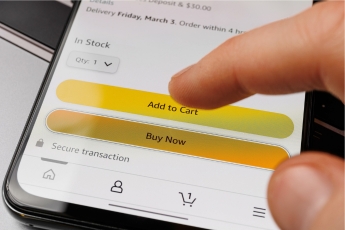
If you have ever clicked “Buy Now” on Amazon and felt a flicker of surprise at how quickly the purchase was complete, you have experienced the power of frictionless design firsthand. There is no cart to review, no second chance to reconsider. Just a single tap, and the transaction is done. That moment is not accidental. It is the product of years of deliberate design choices, from Amazon’s One-Click ordering to its “Customers who bought this also bought” recommendations, which together quietly shape how and when consumers decide to buy. Analysts still estimate that recommendation systems account for roughly one‑third of Amazon’s annual sales, now powered by large‑scale AI models that analyze behavior across every touchpoint.
These features do more than streamline convenience; they subtly guide behavior, shortening decision cycles and nudging customers toward action. At the heart of it all is a sophisticated interplay between algorithmic precision and behavioral economics — one that has turned small psychological cues into a powerful engine for growth.
What is behavioral economics?
Born as a challenge to classical economics, behavioral economics studies how social, psychological, emotional, and cultural factors shape real‑world decision‑making. Rather than assuming perfectly rational agents, it focuses on systematic biases — like status quo bias, loss aversion, and limited attention — and how subtle design choices can “nudge” people toward decisions aligned with their long‑term interests. In financial services, those nudges increasingly show up in personalized savings prompts, smart alerts, and digital journeys that reduce friction at the moments that matter most.
What are some behavioral economics examples?
Behavioral economics has moved from academic theory to operational toolkit across the public and private sectors. A few examples below illustrate both its promise and its limits.
- Health and incentives. Large employers and health plans continue to use behavioral insights — commitment devices, default enrollment, and financial rewards — to improve outcomes in areas like smoking cessation and medication adherence, often outperforming more traditional benefit designs. Evidence reviews of financial incentives for employee health behaviors find that rewards can meaningfully increase participation and short‑term success in quitting smoking and achieving weight‑loss goals. Programs that combine timely reminders with small, immediate incentives tend to work better than information‑only campaigns because they help people overcome the tendency to prioritize short-term comfort over long-term benefits, a mechanism highlighted in behavioral‑science analyses of adherence and incentive design.
- Defaults and organ donation. Organ donation is often cited as a classic example of the power of defaults. Countries that automatically register people as donors unless they opt out often see higher registration rates. However, more recent research shows that increasing registrations alone does not necessarily increase the number of actual organ donations. Healthcare infrastructure, coordination, and public trust also play an important role. The lesson is that changing a default can influence behavior, but lasting results usually require broader system changes.
- Tax compliance and public policy. Governments continue to use behavioral cues — such as social norm messages in tax letters — to improve compliance. Experiments in Europe and elsewhere show that reminding people that “most people in your area have already paid” can meaningfully increase payment rates, especially when messages are clear, simple, and timely.
For community financial institutions (CFI), these examples highlight an important lesson: behavioral economics works best when it is built into everyday products and processes rather than treated as a one-time campaign.
Three places CFIs can apply behavioral economics for SMBs
Understanding how small- and medium-sized businesses (SMBs) make decisions can help CFIs identify strategies to serve them better. Here are three areas in which behavioral economics can make a difference:
- Savings: Turning intentions into cash buffers. SMBs typically know they should build operating reserves, but intention–action gaps are common. Behavioral economics offers several levers community institutions can pull.
- Goal‑based subaccounts and mental accounting. Structuring digital business accounts into labeled “buckets” (equipment fund, tax reserve, payroll buffer) aligns with how owners naturally think about money and makes the act of saving more concrete. CFIs can use data‑driven nudges to suggest target amounts for each bucket based on historical expenses and revenue volatility, making decisions easier for owners.
- Default savings rules. “Set‑and‑forget” features — such as automatically sweeping a small percentage of each deposit into a reserve account — takes advantage of people's tendency to stick with default settings. Providing an easy opt‑out respects autonomy while making the prudent choice the path of least resistance.
- Timely feedback and social proof. Dashboards that highlight progress toward goals, contextual alerts when balances fall below recommended thresholds, and anonymized benchmarking (for example, “businesses like yours keep about X weeks of expenses in reserve”) can help owners take a more realistic view of their finances and encourage course correction. Even small, non‑monetary rewards — badges, recognition in a business‑banking newsletter, or access to exclusive content — can reinforce saving behavior.
2. Lending: Reducing friction and perceived risk. Barriers to borrowing are not just about collateral and credit scores; they also reflect behavioral roadblocks such as complexity, loss aversion, and decision fatigue. CFIs can use behavioral insights across the loan lifecycle.
- Anticipatory, personalized offers. By layering transaction data, seasonality patterns, and behavioral signals (for example, repeated overdrafts or frequent short‑term cash squeezes), institutions can surface tailored credit options before a crunch hits. Delivering simple, pre‑qualified offers within digital and relationship channels reduces the mental cost of initiating a loan conversation.
- Friction‑light journeys with clear anchors. Owners often anchor on the worst‑case scenario and overestimate the effort involved in applying for credit. Streamlined applications, clear timelines, and “what to expect” checklists help counter ambiguity aversion, especially when combined with transparent examples of how similar businesses have successfully used comparable loans.
- Repayment nudges and flexibility. Proactive reminders tied to cash‑in days, gentle prompts when a payment is at risk of being missed, and options to adjust payment dates based on actual cash‑flow patterns can reduce delinquency driven by inattention rather than inability. Where policy permits, small built‑in safety valves — such as one “skip‑or‑shift” payment per year — can address loss aversion and make owners more comfortable taking on productive credit.
3. Money management: From information to guided action. Most SMBs are experts in their product, not in finance, and the complexity of modern banking can easily overwhelm limited time and attention. Behavioral design can turn raw data into digestible, actionable guidance.
- Personalized, just‑in‑time education. Rather than generic content libraries, CFIs can trigger brief, context‑aware insights — for example, surfacing a short explainer on quarterly tax estimates when patterns suggest the owner may face a surprise bill. Delivering advice at the moment a decision is being made increases the odds it will actually influence behavior.
- Smart alerts, not noise. Overdraft warnings, unusual‑spend alerts, and cash‑flow projections work best when they are specific, solution‑oriented, and infrequent enough to avoid alert fatigue. For instance, an alert that says “Your account is likely to be overdrawn next Tuesday; here are three options to avoid it” turns a stressor into a guided choice.
- Positive reinforcement for healthy behavior. Incentive structures that celebrate on‑time payments, improved cash buffers, or consistent use of budgeting tools can harness the power of recognition and habit formation. For community institutions, this can be as simple as relationship‑manager outreach, enhanced loyalty tiers, or access to preferred pricing after sustained strong behavior.
Why CFIs are uniquely positioned
SMBs are pressed for time and capital, and they increasingly expect their financial partners to act as proactive advisors rather than passive service providers. CFIs have an advantage: deep local relationships, granular knowledge of customer behavior, and the ability to pilot targeted behavioral interventions at manageable scale.
By combining behavioral economics with data, analytics, and modern digital channels, CFIs can design nudges that respect autonomy while improving financial outcomes for business customers. Done well, this not only strengthens SMB financial health but also drives more resilient, higher‑quality growth for the institution itself.