Summary:Against a changing interest-rate environment, we explore how loan-level hedging can help CFIs offer competitive fixed-rate commercial loans without taking on more risk than they need to.
Key Insights
Rising interest rates create challenges for community financial institutions balancing competitive fixed-rate lending with interest-rate risk exposure.
Loan-level hedging separates borrower fixed rates from institution exposure, enabling community financial institutions to win commercial lending deals.
Specialist providers enable community financial institutions to offer fixed rates and earn fee income without managing derivative complexity.
Hedging predates the stock market. In 1730, Japan’s Dojima Rice Exchange formalized futures trading, allowing merchants to manage the risk of fluctuating rice prices. Nearly 300 years later, the principle remains relevant: managing exposure to interest-rate movements can help businesses pursue opportunities with greater confidence.
The Federal Reserve (Fed) raised interest rates by 25bp in September 2026, taking the federal funds rate to 3.75%-4.00% for the first time since July 2023. The Fed’s latest projections suggest another increase could follow before year-end, while Treasury yields have also moved higher. For community financial institutions (CFIs), the changing rate environment presents a familiar challenge: how to offer borrowers competitive fixed-rate loans without taking on excessive interest-rate risk?
Locking in a fixed rate for a borrower can leave the institution exposed if market rates move, while pricing defensively to protect margins may make it harder to win business. Loan-level hedging offers one way to manage this trade-off. By separating the fixed rate a borrower pays from the institution’s underlying interest-rate exposure, CFIs can compete for fixed-rate commercial loans that might otherwise be too risky or difficult to structure.
Understanding Loan-Level Hedging
Larger banks often use interest-rate swaps to manage the exposure associated with fixed-rate lending. In a traditional back-to-back arrangement, the lender enters into a swap with the borrower and an offsetting swap with a dealer. The borrower-facing swap establishes the agreed fixed-rate arrangement for the borrower, while the dealer-facing swap is structured to offset much of the lender’s interest-rate exposure. This arrangement allows the institution to manage its exposure while providing the borrower with fixed-rate payments.
However, establishing and maintaining such programs can be expensive and operationally demanding for smaller institutions. They may need specialist expertise, collateral, complex documentation, additional accounting processes, and dedicated staff. These requirements can discourage CFIs from using swaps consistently, even when doing so could help them win attractive loans.
An alternative is to work with a specialist provider that manages the derivative arrangement. For example, under PCBB’s“Borrower’s Loan Protection® (BLP®) program, the CFI originates a floating-rate loan, while the borrower enters into a separate agreement that provides fixed-rate payments. PCBB holds the derivative on its own balance sheet and manages the associated interest-rate exposure.
This type of structure allows the CFI to offer fixed-rate financing without having to manage a traditional back-to-back swap program itself. The CFI retains the lending relationship and the underlying credit risk, while the specialist provider handles the derivative component. Depending on the arrangement, the institution may also earn upfront fee income.
Is Loan-Level Hedging Right for Your Institution?
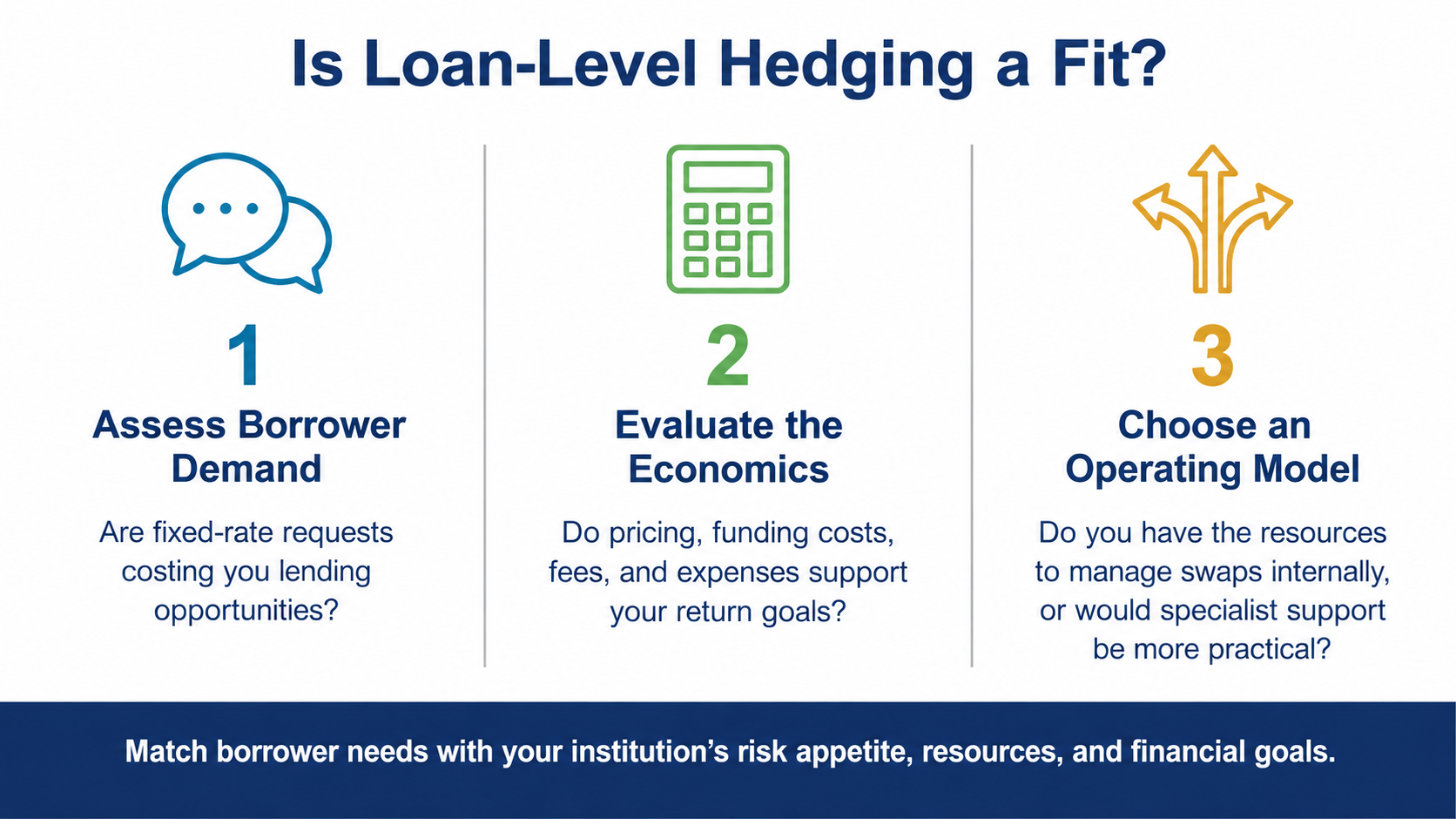
Loan-level hedging may not be suitable for every institution or every commercial loan. CFIs should follow these three steps to evaluate their options.
1. Start with borrower demand. Identify the types of commercial loans your CFI is losing or declining because borrowers want fixed rates. Would offering greater rate certainty help you win business or strengthen existing customer relationships?
2. Evaluate the economics. Compare the expected profitability of a hedged loan with conventional alternatives. Consider funding costs, loan pricing, fees, operational expenses, and the effect on risk-adjusted returns. Additional lending volume is valuable only if it supports your institution’s financial objectives.
3. Choose the operating model. Assess whether your institution has the expertise and resources to manage traditional swaps or whether a specialist provider could offer a more practical solution. Make sure you understand the pricing, documentation, counterparty risks, and responsibilities associated with each approach. image-from-clipboard.png1.56 MB
How Loan-Level Hedging Helped a CFI Compete
The National Bank of Coxsackie, a New York CFI with $512MM in assets, wanted to expand its commercial lending business, including larger, more complex loans. But its rates were falling short of competitors’ offerings, costing it desirable lending relationships. The CFI needed a way to offer more competitive fixed rates without increasing staffing costs.
Loan-level hedging provided a solution. The CFI chose an arrangement that enabled it to offer borrowers fixed-rate loans while outsourcing the derivative process and related administration. This meant its team could focus on their borrower relationships rather than managing the operational complexity of interest-rate swaps.
This approach also enabled the institution to generate upfront fee income from hedging transactions and pursue more complex commercial lending opportunities without adding staff. Its experience illustrates how loan-level hedging can help CFIs expand their lending capabilities and compete for more business.
Turning a Hedging Strategy into a Competitive Advantage
For CFIs, loan-level hedging is more than a technical risk-management tool. Used carefully, it can help align borrower needs with the institution’s risk appetite and commercial objectives. By assessing the economics, choosing an appropriate operating model, and establishing clear controls, CFIs can determine where hedging could strengthen their lending proposition — and compete for opportunities that might otherwise go to larger rivals.
Smart Loan Participation Strategies for CFIs CFIs can improve loan participation efficiency by adopting upgraded third‑party risk and underwriting practices and taking advantage of recent capital relief.
National Preparedness Month Part 2 - How CFIs Can Support SMBs Educating SMBs about the importance of disaster preparedness can help CFIs both strengthen ties to this group and diminish lending portfolio risks that can occur following natural disasters.
This website uses cookies to provide a personalized, informative web experience,
and to support our daily operations with your financial institution.
PCBB does not share or sell your data to other parties.
Please read our Privacy Notice to learn more about the information we collect.