

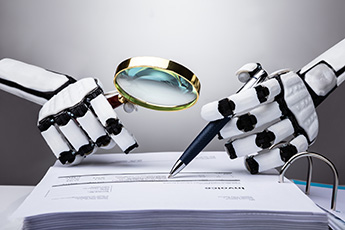
Before the term “artificial intelligence” was coined, the British mathematician Alan Turing in the 1940s theorized how computing machines could someday work beyond just calculating math problems to thinking like a human to solve a wider range of problems. Turing called it “the imitation game,” but today it’s called “the Turing test.” Then in 1956, Dartmouth College mathematics professor John McCarthy convened researchers to workshop the possibility of “thinking machines” — and it was there that McCarthy first called it artificial intelligence (AI).As generative AI evolves, so does the sophistication of AI-generated fake documents, including bank statements, receipts, and utility bills to secure loans or open accounts to launder money. While there are still tell-tale signs of a fake document, the tools — as well as the sheer volume of AI-generated fake documents — are advancing to the point that financial institutions should strongly consider leveraging advanced document verification tools and AI-driven fraud detection to thwart this rising threat.The Rise of AI-Generated Banking DocumentsLarge language models like ChatGPT, Gemini, and Meta AI, as well as diffusion models and other AI-powered image generation systems, are making it easier than ever to fabricate realistic-looking bank statements, identification papers, and other sensitive documents. The tools are either free or cost very little, making the technology very accessible.According to a ThreatGPT webinar poll of fraud specialists across industries, 40% had encountered AI-generated fake documents, 21% said they had not, and 39% were unsure.For financial institutions, more are experiencing first-party fraud by individuals who use AI-generated documents to secure loans, as well as third-party fraud by fraud rings that use fake documents to open accounts for synthetic businesses, which then either secure business loans or launder money.“This is an arms race. We're treating it as an ongoing investment, not a solved problem,” says Ryan Hildebrand, chief innovation officer at the $3.35B-asset Bankwell Bank in New Canaan, Connecticut.Tips for Detecting AI-Generated DocumentsToday, it is still possible to manually spot when a bank statement has been fabricated by an AI tool — though both the sophistication and volume are growing quickly. Utility bills and pay stubs are the most frequently faked documents.Here are some things you might look for to determine manually if a document provided by a customer or potential customer has been generated with AI:
- Formatting anomalies. This could appear as mismatched fonts, misaligned columns, and blurry or pixelated logos. It could also be in an improper file format or exist within a fake web portal design.
- Inconsistent account details. You might see different account numbers on different pages of the same statement, a name that doesn’t match the name used on the application or identifying documents, or incorrect bank branch or contact information.
- Transaction irregularities. Some peculiar transaction details that point to AI are perfectly rounded or repeated deposits, no expenditures for standard monthly expenses, backdated transactions that were processed on days when financial institutions are closed, inconsistent running balances, and deposit descriptions that don’t match the account holder’s stated employer.
- Suspicious file data and missing features. There can be metadata and file origin discrepancies, including documents created in Word or Photoshop, a recent creation date for old statements, or no encryption or digital watermark.
However, in the not-too-distant future, AI tools will evolve to the point that even these anomalies and discrepancies will be erased. Moreover, the sheer volume of AI-fake documents will exacerbate manual processes — making an investment in AI-powered document verification and fraud detection software even more critical for FIs.Leveraging TechnologyHildebrand at Bankwell Bank leverages document verification tools that catch metadata and formatting inconsistencies and software that looks “at the bigger picture — does the identity, device, and transaction history all hang together?”Still, the CFI continues to manually check if anything feels off, he says.“You've got to fight AI with AI,” says Amanda Swoverland, president of the $182MM-asset Hatch Bank in San Marcos, California. “The human eye is probably not going to be able to see some of those things. There is some emerging technology coming out that can spot those types of things. That's where the investment really needs to come in.”It’s critical for your staff to start learning how to spot AI-fake bank statements and other documents. It’s not something you have to handle as a completely manual process. As technology that can spot AI-generated documents is rolled out, you might consider leaning on that software to help detect document anomalies that can point to AI. Regardless of your risk management approach to AI-generated documents, the one thing that’s clear is that while AI gathers the knowledge and tools to make more realistic fake content, your CFI’s AI detection methods should move in lockstep.